Gambling Addiction Isn't About Willpower
1 a.m., standing at the ATM inside a gas station. The screen reads $12. Next paycheck is a week away.
“How did I get here again?” I kept saying in my head. I couldn’t explain, even to myself, why I’d walked back into the sportsbook earlier that night. It must have been the hundredth time I left one of those places saying “I’m done.”
Was my will weak? Was something wrong with my character? I wanted to go back and lecture the version of me who walked in the first time.
When you reach this point, most people arrive at the same conclusion: “This is about will, or about who I am.” That conclusion is wrong by current medical understanding.
It’s not about character or grit. It’s about what’s happening inside your brain.
Gambling addiction is a medical disorder
Gambling was officially reclassified as an addiction more recently than most people realize. In 2013, when the American Psychiatric Association revised its diagnostic manual, gambling disorder was moved out of the “impulse control disorders” category (where it sat alongside things like shoplifting and arson) and into the same category as alcohol and drug addictions. In 2019, the World Health Organization did the same.
Why? Because two decades of brain research showed that the gambling brain changes in the same regions, through the same mechanisms, as the alcohol-dependent brain or the cocaine-dependent brain. Biologically, what’s happening inside the brain during gambling, drinking, or cocaine use looks remarkably similar.
In the United States, roughly 1% of adults (about 2.5 million people) meet criteria for severe gambling problems, and another 5 to 8 million have mild or moderate problems. Since 2018, when the Supreme Court struck down the federal ban on sports betting and opened the door for states to legalize, gambling access has expanded dramatically. Sports betting apps, online casinos, and daily fantasy sites are now available in most states, twenty-four hours a day, from the phone in your pocket. The problem is growing, and the National Council on Problem Gambling and state health departments treat it as a public health issue, not a character flaw.
What’s happening inside the brain
When you gamble for years, your brain physically changes. This isn’t about personality or willpower. It’s cellular. The way your neurons work shifts.
The change has three main parts.
The first is that dopamine gets released too easily. Dopamine normally fires when you do something your body needs to survive: eating, moving, connecting with people. It creates the sensation of “I want this” or “I want more.” In gambling addiction, dopamine fires 1.5 to 2 times harder than normal in response to anything linked to gambling: the sound of a slot machine, the DraftKings logo, the countdown to kickoff. Think of it as a gas pedal that gets pressed on its own.
The second part is that the brakes stop working. The prefrontal cortex, the part of the brain just behind your forehead, handles impulse control. It’s the part that says “stop here.” In gambling addiction, its activity drops by 20 to 30 percent, according to multiple studies. You may feel like you’re pressing the brakes, but they barely engage.
The third part is that specific cues become triggers. The sound of slot machines. The buzz of a push notification. The logo of a betting app. The smell of a casino floor. The graphics of a fantasy-sports lineup. Your brain learns to treat all of these as “a reward is about to arrive.” Just seeing or hearing them fires the gas pedal, whether you’ve decided to stop or not.
These three things don’t happen separately. They happen at the same time. The gas pedal is pressed hard, the brakes barely work, and cues keep arriving. A brain in that state cannot be controlled by thinking “I’ll stop.” This isn’t a story about the strength of your will.
Why gambling
Not everyone who gambles develops an addiction. Certain forms of gambling are much more addictive than others, and the conditions that make them addictive are well understood. There are four main ones.
First, you don’t know when you’ll win. Rewards that arrive unpredictably drive behavior more powerfully than rewards on a fixed schedule. Slot machines, online casinos, and in-play sports betting run on this principle. You might win, you might not. That uncertainty is what pushes the gas pedal hardest.
Second, the result comes fast. A single spin is over in seconds. The next one starts immediately. Your brain can run the “bet, result, bet again” loop hundreds of times in an hour, thousands in a day. Horse racing runs a race every half hour. State lotteries draw once a week. Slots and online sportsbooks run orders of magnitude faster, which is why they hook people faster.
Third, “almost won” comes up constantly. Two matching symbols on a slot. A fantasy team missing by one point. A four-leg parlay that cashed three legs. These are all losses, but your brain processes them closer to wins than to losses. The sense of “I was so close” lingers, and that lingering becomes the motivation to try again.
Fourth, it’s within reach physically and at any hour. Mobile sports betting has been legalized in most states in the last several years. Online casino apps, social casino games, and scratch-off tickets at every corner store put gambling inside your phone or inside your commute. The distance between “I want to” and “I’m doing it” is essentially zero.
When all four conditions line up, a form of gambling is built to change your brain. Just like alcohol or tobacco, there’s individual variation. But when the conditions line up, for most people it’s a matter of probability, not character, that at some point they can’t stop.
The brain changes back
I’ve been writing about the brain physically changing. That change is not permanent.
Your brain adapts to how you use it. Keep gambling, and the brain takes a gambling shape. Keep abstaining, and it slowly moves back. In both substance and behavioral addictions, extended abstinence has been shown to let brain function recover, in study after study.
Which functions recover, and how long it takes, we’ll come back to in later chapters. For now, it’s enough to know: the brain can change back.
References
- American Psychiatric Association (2013). Diagnostic and Statistical Manual of Mental Disorders (5th ed.). American Psychiatric Publishing.
- World Health Organization (2019). International Classification of Diseases, 11th Revision (ICD-11). https://icd.who.int/
- National Council on Problem Gambling (2023). Problem Gambling in the United States.
- Volkow, N.D., Koob, G.F., & McLellan, A.T. (2016). Neurobiologic Advances from the Brain Disease Model of Addiction. New England Journal of Medicine, 374(4), 363-371.
- Potenza, M.N. (2014). The neural bases of cognitive processes in gambling disorder. Trends in Cognitive Sciences, 18(8), 429-438.
- Calado, F., & Griffiths, M.D. (2016). Problem gambling worldwide: An update and systematic review of empirical research (2000-2015). Journal of Behavioral Addictions, 5(4), 592-613.
- Clark, L., Lawrence, A.J., Astley-Jones, F., & Gray, N.A. (2009). Gambling near-misses enhance motivation to gamble and recruit win-related brain circuitry. Neuron, 61(3), 481-490.
- Skinner, B.F. (1953). Science and Human Behavior. Macmillan.
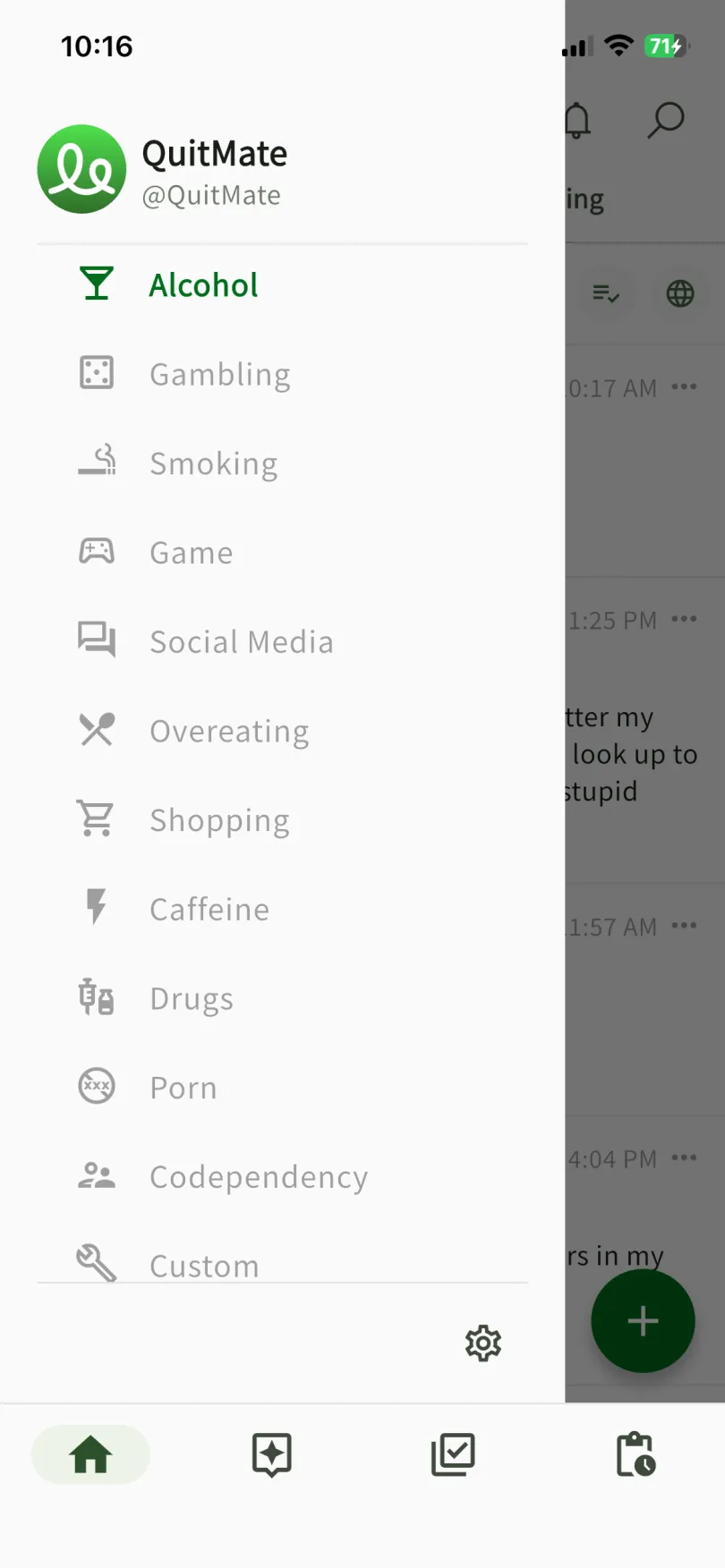
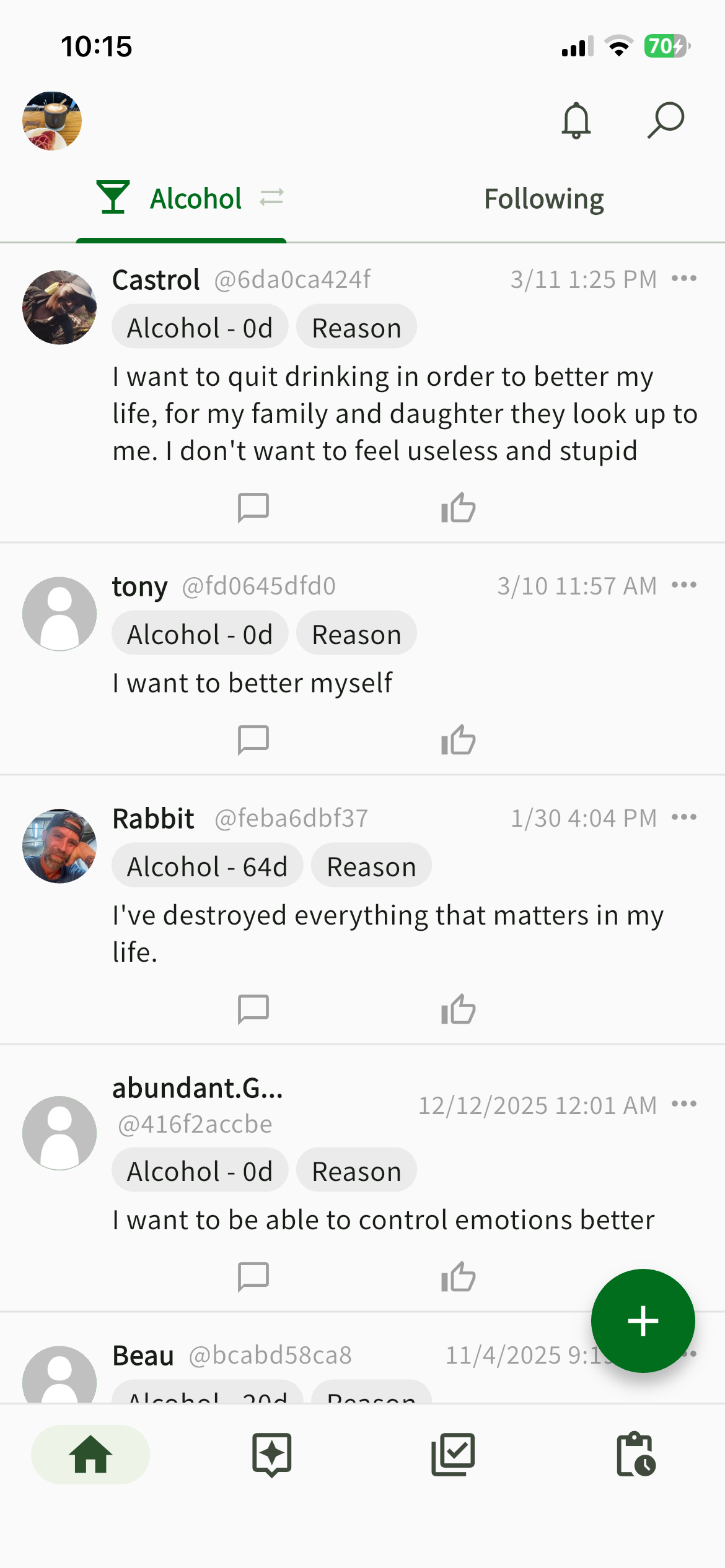

QuitMate
Together, you can quit
Connect anonymously with others who share your struggle. Whether it's alcohol, smoking, gambling, or other habits, you're not alone.