
Cutting Off Access to Money
ImportantThis chapter is general information. For specific debt or legal questions, talk to a consumer-protection attorney, a non-profit credit counselor (NFCC-member agencies), or a free legal aid clinic in your state.
Payday morning. My phone buzzes. “Direct deposit received.” The back of my neck goes hot. Three days earlier, I’d decided to stop for good.
Just pull $100 out where my wife won’t notice. $100 is invisible. $100 will be fine. I pull it out at the gas station ATM and head to the nearest casino. Empty seat at the slots.
By evening, I’ve burned through $1,000. The $100 turned into trip after trip back to the ATM. On the drive home, my head is full of static, trying to work out what I’ll tell my wife.
I’ve lived this scene hundreds of times. Three days of resolve, erased by one notification.
Why “money first”
As the earlier chapters showed, the addicted brain has weakened brakes. Once the craving is running, trying to reason your way out is difficult. If you can’t reason, take away the ability to act. Make it physically impossible. That’s the surest method.
This isn’t “restricting your freedom.” If the money isn’t there, you can’t bet. It’s that simple. You’re not trying to stop with willpower. You’re creating a state where willpower doesn’t have to show up at all.
The first few days of quitting matter most. Addiction research consistently shows that the first days after stopping are the most relapse-prone. That’s exactly why the cutoffs have to happen the same day you decide.
You’re not refusing to trust yourself. You’re refusing to trust the current state of your brain. When the brain heals, you can trust yourself again. This is temporary scaffolding.
What to do tonight (30 minutes)
A list of things to do the same day you decide. Doing all of them is ideal. If that’s too much, pick one. Each one you close reduces tomorrow’s available money.
Set credit card cash-advance limits to $0
Most credit card apps and websites let you set a cash-advance limit. Drop it to zero on every card. Changes sometimes take a day or two to process, but submitting the request already makes it harder.
Physically destroy or hand over cards you use to gamble with
Cards you’ve been using for sports betting deposits, online casino deposits, or cash advances at casinos. Cut them up. Give them to a trusted family member. Feed them into a shredder. You can still get at a credit line without a physical card, but the friction goes up a lot.
Lower your daily limits on payment apps
Venmo, Cash App, PayPal, Zelle, Apple Pay, Google Pay. Lower transfer limits, unlink bank accounts, remove cards. Many of these can feed directly into gambling apps through peer-to-peer transfers or crypto on-ramps.
Delete every gambling-related app and shortcut
- Uninstall every sports betting app (DraftKings, FanDuel, BetMGM, Caesars, etc.)
- Delete casino apps (including social casino games)
- Delete horse-racing and daily fantasy apps
- Delete browser bookmarks and saved logins
- Clear saved passwords in iCloud Keychain or Google Password Manager
- Unsubscribe from every email list related to gambling
- Clear your recent-sites history on your phone
You’re closing the “just log back in” path.
Self-exclude from sportsbooks and casinos
Every state that allows online sports betting or casino gambling has a self-exclusion program. Some examples:
- Most state gaming commissions maintain a voluntary self-exclusion list for in-state casinos
- Online sportsbooks have an in-app “self-exclusion” or “responsible gaming” section. Use it
- Ban yourself from physical casinos in your area (enrollment is usually a form on-site or through the state gaming board)
Self-exclusion periods range from 6 months to lifetime, depending on the state. Pick at least 1 year.
Close online casino and offshore book accounts
Offshore online casinos are grey-market or illegal in most U.S. states, but many people with gambling problems use them anyway.
- Use the account’s self-exclusion feature if it has one
- Remove credit cards and crypto wallets from the deposit method list
Within a week: structural cutoffs
These take a little longer. They reshape your life around not gambling.
Lower daily ATM withdrawal limits
Most banks let you set daily ATM limits through the app or with a quick call. Drop your daily ATM limit to something small, like $60 or $100. This alone kills the “back to the ATM seven times in a night” pattern.
Route your paycheck to an account you can’t touch
Ideal: ask your employer to split your direct deposit so most of it lands in a joint account or a spouse/partner’s account that you can’t access. If only your own accounts are available, move to an account where the card is held by someone else and the password is controlled by someone else. The point is: by the time you’d check the balance on payday, the money has already moved somewhere out of reach.
Put cards, checkbooks, and ID with a trusted person
Credit cards, debit cards, checkbooks, any form of ID that a lender can pull up. Everything goes to someone you trust. “Everything” matters. If you keep even one card, that card will be the one that gets used.
Freeze your credit at all three bureaus
In the U.S., you can place a free credit freeze with Equifax, Experian, and TransUnion. With all three frozen, no lender can pull your credit report to approve a new loan, credit card, or BNPL line. It’s free. It’s reversible when you want a legitimate credit check (you unfreeze temporarily, then refreeze). This is one of the most effective barriers against opening new lines of credit on impulse.
You can also opt out of pre-approved credit card offers at optoutprescreen.com, which stops the pre-screened mail that can tempt new applications.
Telling your family
When you hand money over to your family, they need to be set up on their end too. Walking in and saying “take all my money” without context creates confusion.
What to tell them
At a minimum, three things:
- I have a gambling addiction. It’s a medical condition
- Part of treatment is physically cutting myself off from money
- This is embarrassing, but I need your help
You don’t need a polished explanation. Short is fine.
Set ground rules
Handing over the cards isn’t enough on its own. Agree on some rules.
- A weekly allowance (lunch, gas, minimal spending money)
- How often you’ll show receipts
- How unexpected expenses will be handled
- A regular time to look at the accounts together
This keeps it from feeling like constant surveillance, and reduces your family’s load.
Stay transparent
Share a budgeting app (YNAB, Monarch, Rocket Money, or your bank’s own). Hand over receipts. Not hiding anything is the first step in repairing the relationship.
When you can’t use family
Some people live alone. Some are estranged from family. Some have reasons they can’t bring family into this. Other options:
- A sponsor or a peer from GA (Gamblers Anonymous) can hold your cards
- Ask the social worker at a treatment center or state problem-gambling program
- A non-profit credit counselor (NFCC-member agency) can help structure your finances
- Some banks offer “safe account” or custodial arrangements
- Ask payroll to split your direct deposit with a trusted third party (some employers will do this)
- In extreme cases, ask to be paid a portion in cash
“I can’t tell my family so I can’t do this” isn’t true. There’s always another option besides family. Every option feels embarrassing at first. There are things that matter more than the embarrassment.
Don’t leave yourself a back door
“Let me keep one card, just in case.” “I’ll delete the app, but I’m still logged in on the browser, that’s fine.” “I’ll give my family 90% of the cards and keep 10% for myself.”
Every back door you keep is the first thing the craving reaches for. The “just one” card hits its limit within three days. The still-logged-in browser is open tomorrow night. The 10% in cash is gone by the day after payday.
The reason is simple: the addicted brain is already well-practiced at crossing the last line. Full cutoff. No psychological escape route.
Leaving a back door implies you trust the future version of yourself not to betray this plan. Given the state of your brain, that future version has a high probability of betraying it. A full cutoff isn’t a vote of no confidence. It’s a response to the scientific reality of how the brain works.
If you already have debt
This chapter is mostly about preventing new debt from here forward. If you already have debt, you also need to see and deal with what’s there. That’s the focus of “Facing Your Debt” later in this book.
Three things to know right now:
- You don’t have to deal with debt alone. Free legal aid clinics, non-profit credit counselors (NFCC-member agencies), and state bar lawyer-referral services can all help
- There are legal paths through debt. Debt settlement, Chapter 13 bankruptcy (reorganization), and Chapter 7 bankruptcy (discharge) are all options, each with different conditions and consequences
- Even just knowing your total debt is a step. A lot of people have let “not knowing” turn into a trap of its own
References
- National Council on Problem Gambling (2023). Problem Gambling Resources.
- Ladouceur, R., Lachance, S., & Fournier, P.M. (2009). Is control a viable goal in the treatment of pathological gambling? Behaviour Research and Therapy, 47(3), 189-197.
- Hodgins, D.C., Stea, J.N., & Grant, J.E. (2011). Gambling disorders. The Lancet, 378(9806), 1874-1884.
- Federal Trade Commission. Free credit freezes and fraud alerts. https://consumer.ftc.gov/
- American Gaming Association. Responsible Gaming. https://www.americangaming.org/

QuitMate
Together, you can quit
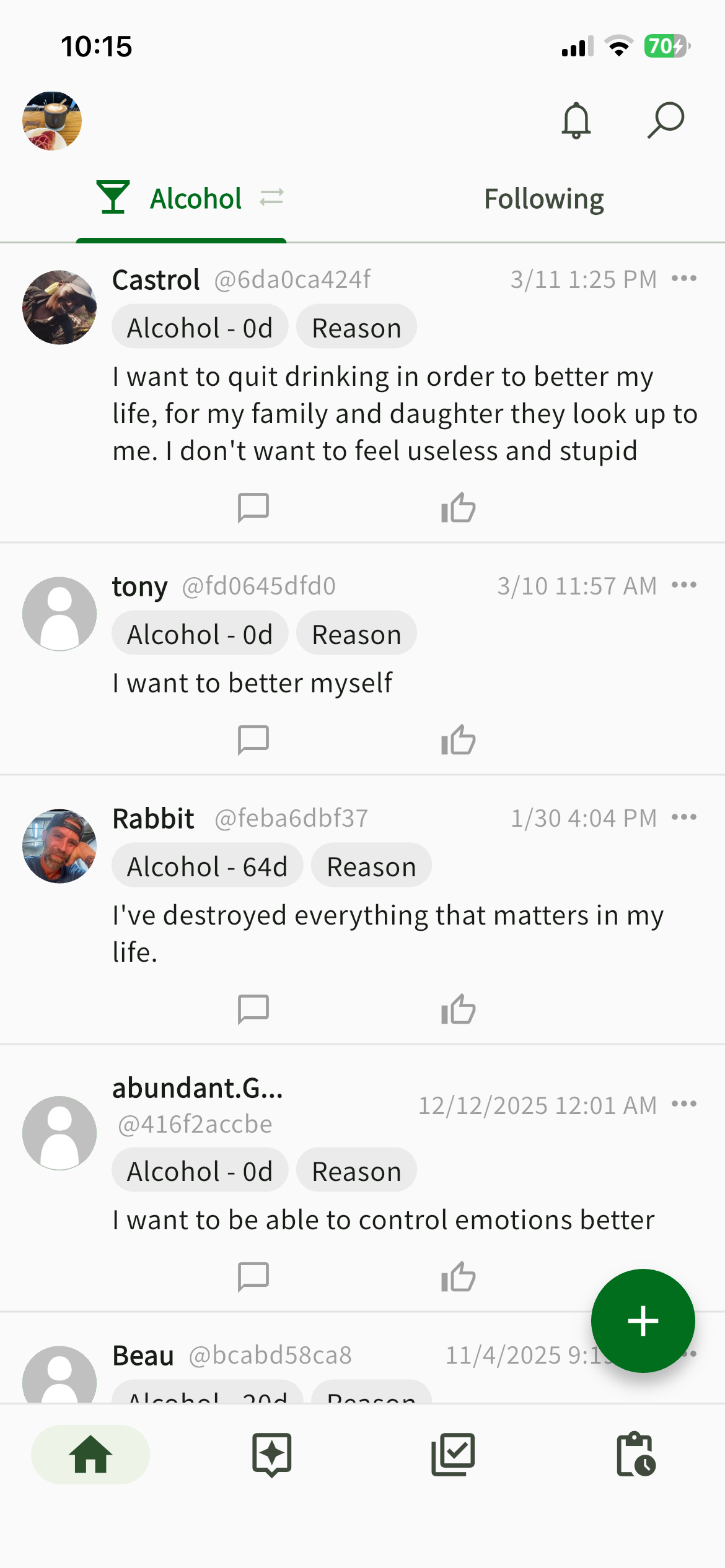
Connect anonymously with others who share your struggle. Whether it's alcohol, smoking, gambling, or other habits, you're not alone.