
Denial: The Wall of 'I'm Fine'
“I’m not an addict.” “I could stop if I really wanted to.” “I just haven’t stopped yet.” “I’m not like those other guys.” “He was bad enough to need treatment. I’m not there yet.”
One person said these, out loud, for five years. In those five years, the debt passed $50,000. His family discovered the hidden debt, and only then did he admit he couldn’t stop.
For those five years, saying “I could stop if I wanted,” he didn’t think he was lying. He believed it. That’s denial.
What denial is
Denial is the mind’s way of treating a fact as “not a fact.” It’s not a conscious lie. The person truly feels what they’re saying.
In addiction medicine, denial is treated as a symptom of the disease. It shows up in gambling disorder, alcohol use disorder, substance use disorders, all of them.
Denial’s job is to protect the person from pain. Admitting “I have an addiction” hurts. To soften the hurt, the brain filters the world through “I’m fine.”
The filter is invisible from the inside. You’re looking through it, so you can’t see it. That’s what makes denial hard to spot.
Common denial patterns
”I could stop if I wanted to”
The most common one. The person really believes it. Except they haven’t actually stopped.
Reality: if you’ve tried to stop many times and haven’t, that’s the definition of “I can’t stop."
"I’m not in financial trouble”
There’s debt. But it feels “not bad enough.” “I can handle this on my income.” “Other people have worse debt than me.”
Reality: put the debt amount and a repayment plan on paper. Have a third party look at whether this is actually “not bad."
"If I stop gambling, I’ll just get unhealthy in other ways”
“I’ll have no way to manage stress.” “I’ll replace it with another addiction.” “People need a release valve.” These arguments run in your head.
Reality: gambling doesn’t relieve stress. You’re just not noticing it for a while, and stress is larger when you walk out than when you walked in. If you experience gambling as “stress relief,” you already have the structure of addiction.
”I’m different from those people”
“Those are real addicts. I’m different.” “I’m still doing my job. My family life is okay.” “I still have control.”
Reality: if you had control, you wouldn’t be reading this book.
”My family isn’t affected”
“I haven’t told them, so they don’t know.” “It’s not affecting them.” “I’m using my own money, so it’s my issue.”
Reality: your family usually notices. They notice and stay quiet. The act of hiding, by itself, is affecting your family.
”I’ll stop eventually”
“Can’t do it now, but someday I will.” “When the kids are older.” “When work calms down.” “When money is easier.” “Someday” never arrives.
Reality: pushing “someday” into the future, forever, is itself a hallmark of addiction.
”I actually enjoy gambling”
“It’s not something to stop, it’s a hobby.” “Other people spend money on hobbies too.” “It’s like golf, or travel.”
Reality: hobbies leave you feeling good afterward. If you don’t feel better after gambling, it isn’t a hobby. As we saw in Chapter 2 (the dopamine trap), the addicted brain stops registering enjoyment.
How to notice denial
”What would I think if someone else said this?”
Run your own thoughts through an outside view. “If someone told me ‘I could stop if I wanted,’ and they’d tried and failed ten times, what would I think?”
Almost everyone can calmly answer: “that’s a person who can’t stop.” Point that calm view at yourself.
Use numbers
Denial runs on feelings. Facts run on numbers.
- How much did you spend on gambling last month?
- How much in the last year?
- What’s the total debt?
- How many times have you “decided to stop”?
- What’s the longest stretch you’ve actually stopped for?
Put these on paper. The gap between the numbers and how you feel shows up clearly.
Ask family or friends, honestly
Ask someone you trust: “Do you think I have a gambling addiction?” Usually, they’ve thought so for a while. Often, you’re the last person to see it.
Try a quick self-screen
There are several addiction self-checks. A simple one is the “Lie/Bet” questionnaire, two questions:
- Have you ever lied to people important to you about how much you gamble?
- Have you ever felt the need to bet more and more money?
Two yeses suggest a high likelihood of gambling disorder. This isn’t a diagnosis, but it’s a wedge into the wall of denial.
How to start breaking through denial
Admit “I might be in denial”
This sounds contradictory. If you’re in denial, how can you admit to being in denial?
You actually can. Say, in your head: “I might be in denial right now.” That alone makes the filter partially transparent for a moment.
You don’t have to fully break out of denial. Just holding “I might be in denial” shifts how you behave.
Write your state down
Don’t think. Write. Writing makes the filter visible to you.
Things to write:
- Last month’s spending
- Total debt
- Number of times you’ve “decided to stop”
- How your family relationships have changed
- How many times you’ve lied to yourself
Read what you wrote the next morning. It often reads differently in the morning than it did at night.
Get away from voices that reinforce denial
Distance yourself from people and content that strengthens denial.
- The friend who says “you’re not that bad”
- The “everyone does it” crew
- Social media or YouTube channels that treat gambling casually
The longer you stay plugged in, the more reinforced the filter gets.
Spend time where denial gets weaker
Actively seek spaces where denial loses ground.
- GA or other support groups (hearing people who’ve been through the same thing)
- Memoirs and accounts from people in recovery
- Reading timelines in the QuitMate community
- Time with trustworthy family
- Medical providers and counseling centers
Seeing “people with the same symptoms as me” thins the filter. “I’m different” turns into “I’m the same” in specific moments.
Denial comes back
Denial isn’t “broken through once, then done.” It keeps coming back.
Even well into recovery, denial can return. “I’m cured now.” “Just one more time would be fine.” “I can be a normal person again.” These are late-stage denials.
Whether you can recognize returning denial as a symptom, or fall for it, is often the difference between staying in recovery and relapsing.
References
- Johnson, V.E. (1986). Intervention: How to Help Someone Who Doesn’t Want Help. Hazelden.
- Carnes, P. (2001). Out of the Shadows: Understanding Sexual Addiction (3rd ed.). Hazelden.
- Cunningham, J.A., Hodgins, D.C., & Toneatto, T. (2009). Relating severity of gambling to cognitive distortions in a representative sample of problem gamblers. Journal of Gambling Issues, 23, 147-153.
- Johnson, E.E., Hamer, R., Nora, R.M., Tan, B., Eisenstein, N., & Engelhart, C. (1997). The Lie/Bet Questionnaire for screening pathological gamblers. Psychological Reports, 80(1), 83-88.
- Lesieur, H.R., & Blume, S.B. (1987). The South Oaks Gambling Screen (SOGS): A new instrument for the identification of pathological gamblers. American Journal of Psychiatry, 144(9), 1184-1188.
- Ferris, J., & Wynne, H. (2001). The Canadian Problem Gambling Index: Final Report. Canadian Centre on Substance Abuse.
- Khantzian, E.J. (2003). The self-medication hypothesis revisited: The dually diagnosed patient. Primary Psychiatry, 10(9), 47-54.
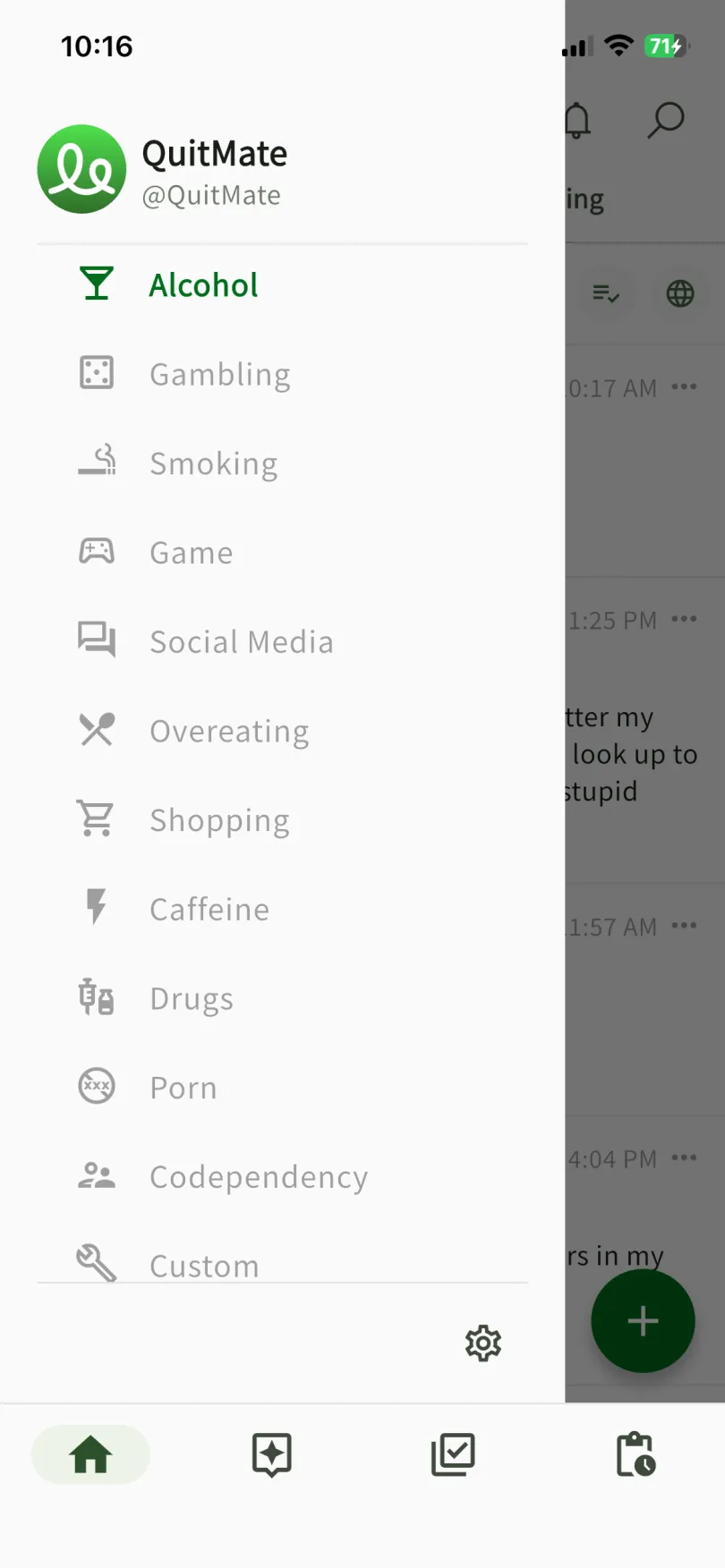
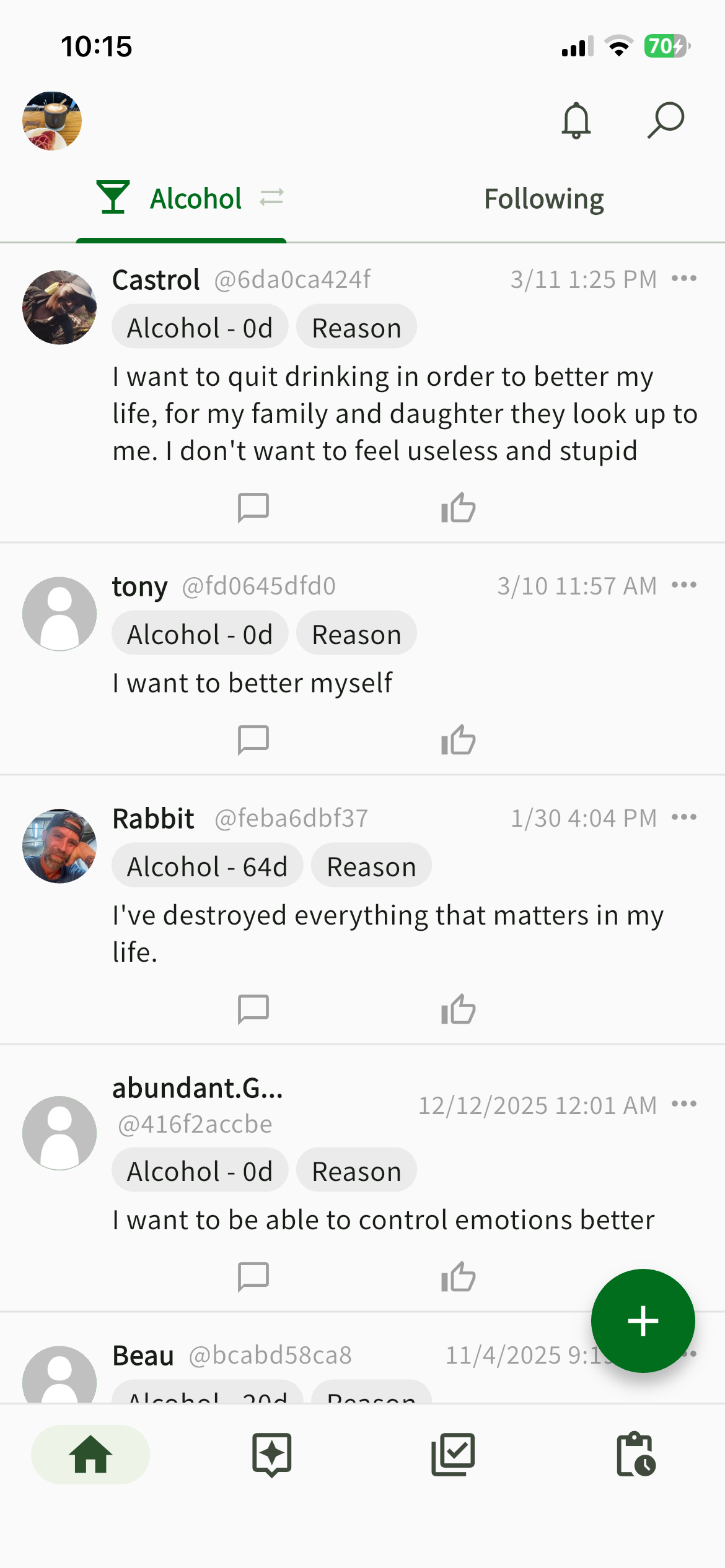

QuitMate
Together, you can quit
Connect anonymously with others who share your struggle. Whether it's alcohol, smoking, gambling, or other habits, you're not alone.