
Reflection Changes Behavior: What Behavioral Economics Tells Us About Recovery

You open a calorie-tracking app, log your breakfast, and then at lunch you pause before ordering that extra side. You weren’t hungry for discipline. You just saw your own numbers from three hours ago, and that was enough to shift the decision. The calorie count didn’t force anything. The brief act of noticing did the work.
That small effect, where a moment of reflection changes the behavior that follows, turns out to be surprisingly well-documented.
The Ten Commandments experiment
Behavioral economist Dan Ariely ran a now-well-known experiment at MIT, Yale, and other universities (Mazar et al., 2008).
The setup: students took a test, then self-reported their scores with no verification. They were deliberately given the opportunity to cheat. And some did inflate their scores.
But one group was asked, right before the test, to “try to recall as many of the Ten Commandments as you can.” In that group, cheating dropped to nearly zero.

The interesting part: almost none of the students could actually recite the commandments correctly. Some couldn’t even produce “Thou shalt not steal.” Ariely further confirmed that the same effect occurred when non-religious students were simply asked to sign an honor code.
The content of the reflection didn’t matter. The act of briefly considering “what kind of person do I want to be?” was sufficient to change behavior. Whether participants recalled any specific commandment was irrelevant to the effect.
Note: In 2021, data integrity concerns were raised about some of Ariely’s dishonesty research (Simonsohn et al., 2021). The Ten Commandments experiment was not the direct subject, but the broader context warrants caution.
The gap between impulse and action
This finding connects to addiction recovery in a useful way.
Research by Gollwitzer and colleagues (Gollwitzer & Sheeran, 2006) shows that vague resolutions (“I’ll just stop”) are significantly less effective than specific pre-planned responses: “If I get the urge to drink, I’ll have a glass of water first” or “If I walk past the pachinko parlor, I’ll take a deep breath.” This technique, called implementation intentions, substantially increases goal achievement rates.
The mechanism is similar to what happened in the Ten Commandments experiment. Pre-planning creates a small gap between impulse and action. That gap is where different choices become possible. It doesn’t require enormous willpower, just a moment of structured reflection before the critical moment arrives.
For more on why self-blame is counterproductive in recovery, see “Stop Blaming Yourself.”
Self-compassion outperforms self-criticism
Research by Kristin Neff at the University of Texas (Neff & Germer, 2013) found that a self-compassion training program reduced self-criticism and stress. Since stress is a known relapse trigger, this has direct relevance to addiction recovery.
The mechanism is straightforward. Harsh self-judgment (“I did it again, I’m worthless”) generates stress, and stress drives people back toward addictive behavior. It creates a feedback loop.
Self-compassion breaks the loop. Treating a slip as data (what triggered it? what were you feeling?) rather than as evidence of personal failure makes it possible to learn from the experience instead of being crushed by it. Over time, this kind of observation can reveal the deeper issues underlying the addiction.
Everyday forms of reflection
Reflection doesn’t require formal journaling or meditation. Small moments work: reading someone else’s recovery post and thinking “right, I wanted to quit too.” Looking at a day counter. Glancing at something you wrote last week.
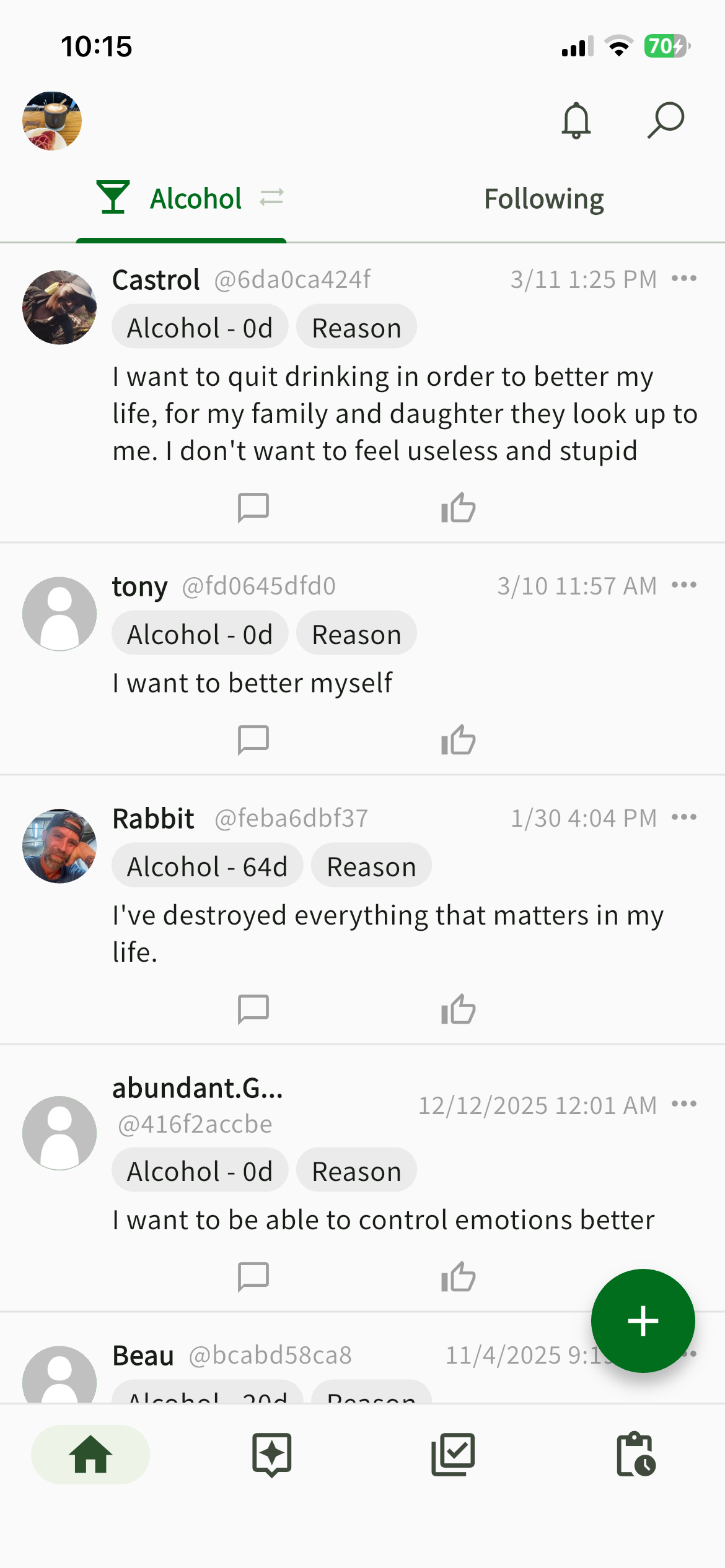
Research shows that peer support improves treatment outcomes, and part of the reason is that community participation naturally creates moments of reflection. Reading a post on an app like QuitMate, sending a reaction, seeing others’ progress, each of these functions as a prompt to briefly reconnect with your own intentions.
The practical takeaway
The Ten Commandments experiment demonstrated that people who couldn’t remember what they were reflecting on still changed their behavior. The bar for effective reflection is remarkably low.
A few seconds, once a day, spent touching the thought “why did I want to quit?” can shift the choices that follow. Some days go well. Some don’t. But a day that includes even one moment of reflection is measurably different from one that doesn’t.
References
- Ariely, D. Predictably Irrational: The Hidden Forces That Shape Our Decisions. HarperCollins, 2008.
- Mazar, N., Amir, O., & Ariely, D. “The Dishonesty of Honest People: A Theory of Self-Concept Maintenance.” Journal of Marketing Research, 45(6), 633-644, 2008.
- Gollwitzer, P. M., & Sheeran, P. “Implementation Intentions and Goal Achievement: A Meta-Analysis of Effects and Processes.” Advances in Experimental Social Psychology, 38, 69-119, 2006.
- Neff, K. D., & Germer, C. K. “A Pilot Study and Randomized Controlled Trial of the Mindful Self-Compassion Program.” Journal of Clinical Psychology, 69(1), 28-44, 2013.
- Ariely, D. The (Honest) Truth About Dishonesty. Harper, 2012.
- Simonsohn, U., Simmons, J. P., & Nelson, L. D. (2021). “Evidence of Fraud in an Influential Field Experiment About Dishonesty.” Data Colada, #98.


QuitMate
Together, you can quit
Connect anonymously with others who share your struggle. Whether it's alcohol, smoking, gambling, or other habits, you're not alone.