When Do the Effects of Quitting Alcohol Start? A Data-Backed Timeline
Day 2 of no drinking. Nothing has changed yet. If anything, it feels worse.
I can’t sleep at night. During the day, my mind is foggy and I can’t focus. The irritability won’t stop. I bet a lot of people searching “when do effects of quitting alcohol start” ended up here.
Let me cut to the conclusion. The earliest you’ll notice effects is around Day 4, and it takes about 2 weeks before you feel genuinely confident things have changed. But “getting worse before getting better” is completely normal, and there’s a clear neurological reason for it.
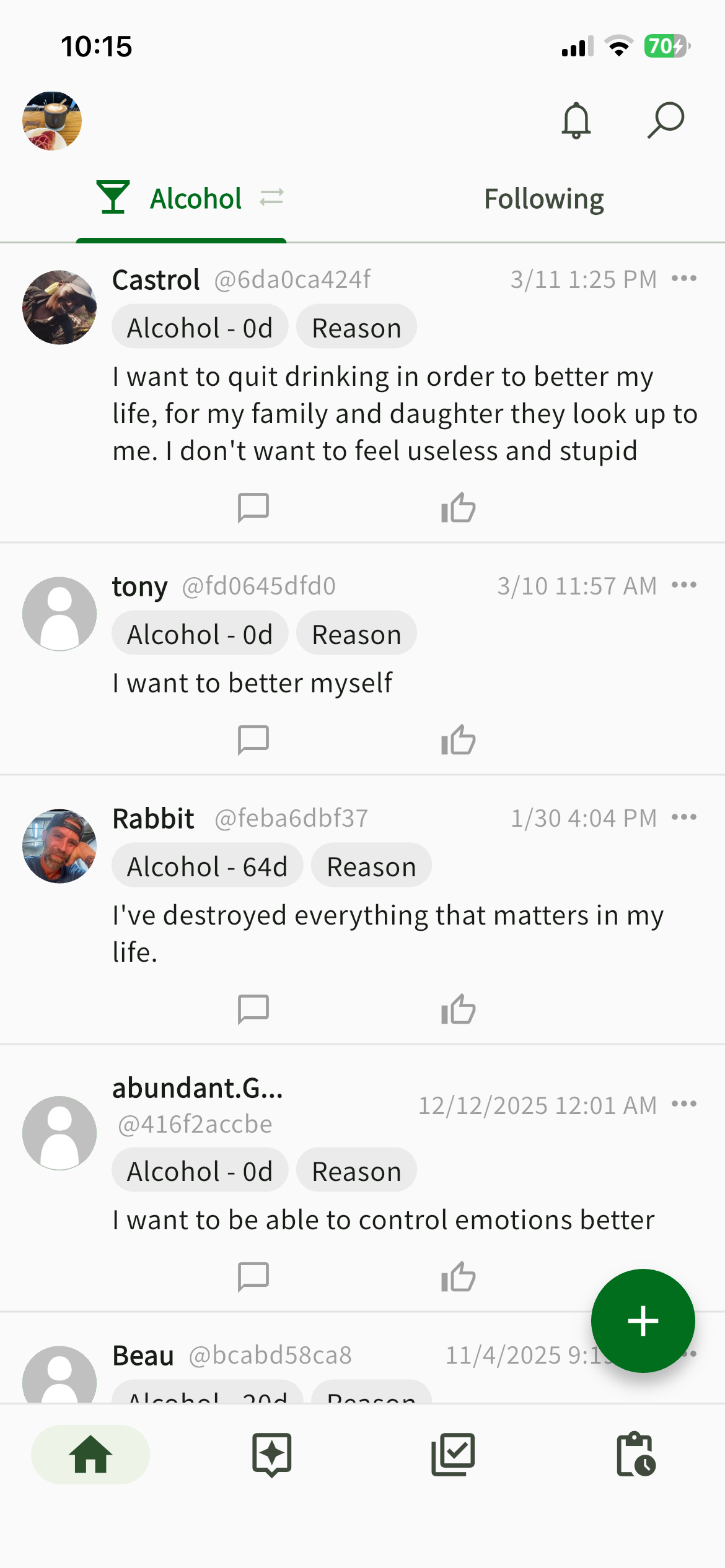
I run a recovery app called QuitMate, and for the alcohol category alone, we have roughly 750 users and data from over 2,850 quit attempts. When I analyzed user posts, the words “changed,” “getting better,” and “feeling the effects” appeared most frequently on Day 4 of sobriety. The first sign of progress comes right after surviving the hell of the first 3 days.
In this article, I’ll break down “why things get worse at first” and “when each symptom subsides,” drawing on real user posts and neuroscience research.

Why It Gets “Worse” at First
The discomfort in early sobriety isn’t in your head. Your brain is in a state of confusion.
Your “Pleasure Receptors” Have Shrunk
When you drink alcohol, your brain releases a flood of dopamine. Dopamine is often called the “pleasure chemical,” but more accurately, it creates the urge of “I want more.” The actual feeling of pleasure is handled by a different system in the brain. What dopamine really produces is the “I want another drink” impulse.
Here’s where the problem starts. When you drink every day, your brain decides there’s “too much dopamine” and starts reducing the number of receptors that pick up the signal. When you quit drinking with fewer receptors, normal dopamine levels produce a signal too weak to register.
The result: nothing feels good.
Listening to music, watching your favorite show — nothing clicks. One user posted on Day 10: “Is it possible that feeling like life isn’t enjoyable is also part of withdrawal?” The answer is yes. Your receptors are diminished, so ordinary stimulation can’t get the signal through. Give it time, and they come back.
Withdrawal Is the Flip Side of Tolerance
There’s another mechanism worth understanding: tolerance. The experience of “I can’t get drunk on the same amount anymore” is proof that your brain has recalibrated to treat alcohol as the new normal. A seesaw analogy helps here. Every time alcohol tips the seesaw toward pleasure, your brain adds weight to the pain side to restore balance. Over time, those weights on the pain side become permanent.
So what happens when you quit? The force on the pleasure side drops to zero, but the weights on the pain side stay put. The seesaw slams down toward pain. That’s withdrawal. Insomnia, irritability, sweating, mild tremors — all products of this “tilt.”
QuitMate data shows that 57.8% of all resets happen within the first 3 days. Just knowing this can help more people push through those hellish first 3 days without breaking. When you understand what’s happening, you can endure it.
Symptom-by-Symptom Timeline (Answering “When Does It Get Better?”)
From here, I’ll go through each symptom in a Q&A format, cross-referencing real user posts. First, here’s an overview table.
| Symptom | Improvement Begins | Mostly Stabilized |
|---|---|---|
| Insomnia | 3-5 days | 1-2 weeks |
| Irritability | 1 week | 2-4 weeks |
| Facial puffiness | 4-7 days | 2 weeks |
| Low motivation / inability to enjoy things | 2-4 weeks | 1-2 months |
| Reduced stress tolerance | 2-4 weeks | Several months |
Here’s each one.
”How Long Will the Insomnia Last?”
It starts improving in 3-5 days and mostly stabilizes within 1-2 weeks.
Alcohol suppresses the central nervous system. When you drink daily, your brain cranks up arousal to maintain balance. The moment you stop drinking, that heightened arousal is all that remains. That’s why you can’t sleep.
“I can’t fall asleep and I wake up way too early. I’ve failed before because the stress of not being able to sleep when I had work the next day was too much.” (Day 1)
But this settles down within days. By Day 5, posts like “I’m falling asleep before I know it” start appearing. Giving up because of 2-3 days of insomnia isn’t worth it. I wrote more about the progression of insomnia in “Effects of 1 Week Without Alcohol."
"When Does the Irritability Go Away?”
It peaks around Days 2-3. It gets significantly easier after 1 week, but it can take 2-4 weeks to fully disappear.
“Day 3 done! I’ve got headaches and irritability, but sitting around doing nothing just makes me think negative thoughts, so I’ve been channeling my energy into yard work at my parents’ place.” (Day 3)
The root cause of irritability is that your dopamine receptors haven’t fully recovered yet. But there’s a clear shift in tone after the 1-week mark. By Day 8, more and more people are saying things like “the urge to drink has dropped dramatically” and “my mental state is stabilizing."
"When Does the Facial Puffiness Go Away?”
Changes start appearing in 4-7 days, and things look noticeably clearer by 2 weeks.
Alcohol disrupts your body’s water balance. When you stop, excess water starts draining within days. By Day 7, people are saying “my skin has improved dramatically,” and by Day 10, “I think my face looks slimmer.” Changes in skin and puffiness are the fastest and most visible effects of quitting. I covered the second-week changes in more detail in “Effects of 2 Weeks Without Alcohol."
"How Long Will This ‘Nothing Is Enjoyable’ Feeling Last?”
2-4 weeks. For some, it can take up to 2 months.
Your dopamine receptors are still diminished, so everyday stimulation can’t reach your brain. Everything feels gray. It creeps in gradually after you’ve gotten past the physical withdrawal.
“Nothing is fun. Honestly, I don’t want to talk to anyone. Don’t want to see anyone. Don’t want to go to work.” (Day 15)
It’s subtler than physical withdrawal, but this is the real cause of relapse. That said, one person wrote on Day 15: “I had a normal night out, joking around, feeling that pleasant tiredness afterward. Turns out I didn’t need alcohol nearly as much as I thought.” I wrote about changes from Week 3 onward in “Effects of 3 Weeks to 1 Month Without Alcohol.”
Why Does It Feel Like “I’ve Become Weaker to Stress”?
Improvement starts in 2-4 weeks, but full recovery can take several months.
After a while into sobriety, some people feel like they’ve become less resilient than before. A minor mistake at work sends them into a tailspin. Other people’s words sting more than they used to.
“The stress at home has been truly brutal. I’ve gone past irritability into just feeling empty. If I were still drinking, I’d definitely be missing work, and my mental state would’ve been even worse.” (Day 21)
Your body has a built-in system for absorbing and processing stress. Chronic drinking damages this system. It might look like you’ve “become tougher,” but in reality, the system is just too worn out to function. When you quit drinking, the broken system is exposed. That’s why it feels like you’ve “gotten weaker.”
One person wrote on Day 14: “My mental rough patches have eased up a bit, the sluggishness is fading. That feeling of hitting rock bottom seems to be happening less.” Recovery is subtle, but it’s real. This system takes longer to heal than dopamine receptors, so don’t rush it.
Takeaway
The effects of quitting alcohol can show up as early as Day 4. It takes about 2 weeks to feel confident in the changes. Factor in stress tolerance, and it’s several months. That’s a long road. But the first 3 days are the darkest. Roughly 60% of resets are concentrated right there. Flip that around, and it means the light starts breaking through on Day 4.
Your brain will recover. The receptors will come back.

QuitMate
Together, you can quit
Connect anonymously with others who share your struggle. Whether it's alcohol, smoking, gambling, or other habits, you're not alone.