The Complete Guide to Quitting Alcohol: Every Effect from Day 1 to 1 Year

“Effects of quitting alcohol.” This phrase gets searched 50,000 times a month.
That’s how many people want to know what will change if they stop drinking. But the information online is scattered and disorganized. A one-week timeline sits on the same page as a three-month one, and you can’t figure out which part applies to where you are right now.
I run QuitMate, an app for overcoming addiction. Across all categories, over 8,000 users have logged more than 28,000 quit challenges. For alcohol alone, that’s 767 users and 2,884 challenges. The effects of quitting alcohol come in stages. The first few days are brutal. But push through, and your body starts responding in sequence at one week, two weeks, one month. Knowing what happens at each stage makes you far less likely to give up along the way.
Get a quick overview of each stage here, then read the detailed articles for whatever interests you most.
First Things First: Why Does Quitting Alcohol Actually Work?
Alcohol is sometimes called a “dirty drug.” It doesn’t target just one spot. It acts on multiple areas of the brain simultaneously. It enhances the brain’s inhibitory brakes while dampening the excitatory accelerator, and it directly stimulates the brain’s reward circuits. Every time you drink, your brain recalibrates and learns to treat that state as “normal.”
The result: without alcohol, your brain is thrown off balance. You can’t sleep, you’re irritable, nothing feels enjoyable. The discomfort in early sobriety is your brain trying to recalibrate from a state that was built around alcohol.
As you keep going without alcohol, your brain gradually restores its natural balance. The reward system normalizes, the regions responsible for judgment begin to repair, and eventually “not drinking” becomes the default. This process takes anywhere from days to months. That’s why the effects of quitting appear in stages.
Effects of Quitting Alcohol: Days 1-7 — The Morning After Withdrawal
The first three days aren’t about “effects.” They’re about surviving withdrawal.
When a brain that’s dependent on alcohol is suddenly cut off, the balance between excitation and inhibition collapses. Insomnia, sweating, irritability, headaches. Some people get tremors. One QuitMate user posted, “Day one. Shaking and nauseous, I crawled into bed.”
But day three is the peak. QuitMate’s data shows that roughly 60% of people who relapse do so within the first three days. About 70% of those who make it past day three go on to reach one week. Around day four, sleep quality shifts dramatically. Your liver is freed from processing alcohol, and your body can truly rest for the first time. Facial puffiness subsides, and your mornings become clear-headed.
Read more: What Happens After 1 Week Without Alcohol [Data from 750 Users]
Effects of Quitting Alcohol: 2 Weeks — The Numbers Start Moving
In the second week, it’s not just how you feel that changes. The numbers start changing too.
Liver values. Blood pressure. Weight. People who failed a health screening, got retested, and surprised their doctor with the improvement — that story comes up a lot. This is when serious internal repair is underway.
Your sense of taste sharpens as well. Many people say their morning coffee tastes completely different. The sensory nerves dulled by chronic alcohol use are starting to recover.
That said, you might hit a sudden bout of insomnia one night during week two. It’s a temporary disruption caused by neurotransmitter levels rebalancing. If you understand the mechanism, you can ride it out knowing it will pass in a few days.
Read more: The Surprising Effects of 2 Weeks Without Alcohol: Body and Mind Changes
When Do the Effects Start? As Early as Day 4, Confidence by Week 2
“I quit drinking, but when will I actually feel the difference?”
Different symptoms recover on different timelines. Sleep starts improving within 3-5 days. Irritability eases after a week, though it can take 2-4 weeks to fully resolve. The hardest to shake is the feeling that nothing is enjoyable — that flatness can take up to two months.
The brain receptors depleted by daily drinking need time to return to normal levels. Feeling like “nothing is getting better” in the early days is completely normal. Your receptors are still on their way back.
Read more: When Do the Effects of Quitting Alcohol Start? A Timeline Explained
Effects of Quitting Alcohol: 3 Weeks to 1 Month — The Wall
Week three. This is where a lot of people suddenly struggle.
The physical changes have plateaued, and the novelty of quitting has worn off. A nagging thought — “How long am I supposed to keep this up?” — starts creeping in. This is the period when the most users stop logging in the app.
The part of the brain responsible for judgment only begins to recover around the three-week mark, and it’s still not fully there. It’s a dangerous moment when overconfidence (“I’ve got this”) collides with the impulse (“Just one drink wouldn’t hurt”).
On the other hand, reaching one month gives you solid data. Blood pressure improvement, liver function recovery, better digestion. The numbers that were still ambiguous at one week are clearly better at one month.
Read more: Quitting Alcohol for 3 Weeks to 1 Month: Effects and How to Overcome the “Week 3 Wall”
Effects on Gray Hair, Skin, and Hair
“Does quitting alcohol reduce gray hair?” is a surprisingly common search. Pigment cells that have completely shut down due to aging won’t come back just because you stop drinking. Expecting gray hair to “disappear” is setting yourself up for disappointment.
That said, alcohol damages your hair through multiple pathways. The metabolic process drains your antioxidant defenses. Chronically elevated stress hormones deplete the stem cells responsible for pigmentation. Impaired nutrient absorption starves your hair of raw materials. If quitting alcohol stops these processes, it may at least prevent further damage.
The first visible change, though, happens in your skin. Simply stopping dehydration and inflammation is enough to visibly brighten your complexion. When it comes to beauty benefits of quitting alcohol, skin is the surest bet.
Read more: Does Quitting Alcohol Reduce Gray Hair? Effects on Hair Explained
Effects of Quitting Alcohol: 3 Months to 1 Year — Your Judgment Comes Back
Around the three-month mark, changes start showing up not just physically but cognitively.
“My judgment came back.” “I stopped being controlled by impulses.” These kinds of reports spike during this period. QuitMate’s data shows that only about 8% of users make it to three months. But roughly 76% of those who do go on to reach six months. Three months is the biggest turning point. Once you clear it, staying sober becomes much easier.
Past six months, the behavioral pattern of “not drinking” starts to solidify as a neural pathway. The awareness of “I’m quitting” fades, and not drinking simply becomes normal. After a year, most people find that their time, money, and relationships have all fundamentally changed.
That said, long-term sobriety comes with its own losses. The detailed article covers that as well.
Read more: The Incredible Effects of Quitting Alcohol: What Happens from 3 Months to 1 Year
Timeline Overview
| Period | Key Changes | % Still Going |
|---|---|---|
| Days 1-3 | Peak withdrawal. Insomnia, irritability, sweating. The biggest wall | 53% |
| Days 4-7 | Sleep quality improves. Clearer mornings. Puffiness starts fading | 36% |
| 2 weeks | Liver values improve. Taste returns. Weight starts shifting | 26% |
| 3 weeks | Skin stabilizes. Blood pressure drops. Watch out for the “week 3 wall” | 21% |
| 1 month | Gut recovery. Savings become noticeable | 16% |
| 3 months | Judgment recovers. Impulse control gets easier | 8% |
| 6 months | ”Not drinking” shifts from effort to habit | 5% |
| 1+ year | Life structure transforms. Quality changes in time, money, and relationships | 3% |
Retention rates calculated from 767 alcohol users and 2,884 challenges on QuitMate
Survive the first three days, and day four brings a different morning. By two weeks, the numbers prove it. Week three throws another wall at you. At one month, you have real confidence. By three months, your judgment is back. Six months in, the habit has flipped. After a year, your entire life looks different.
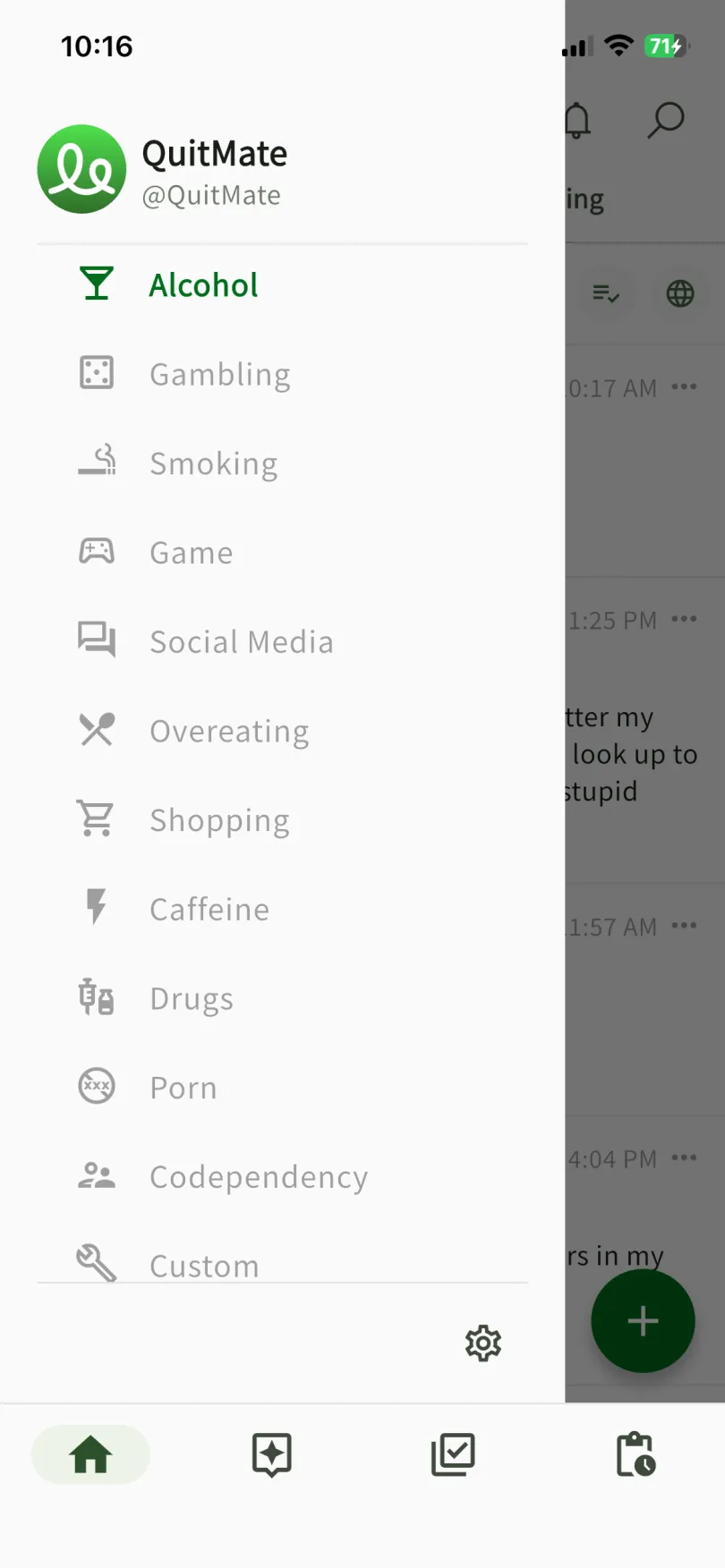
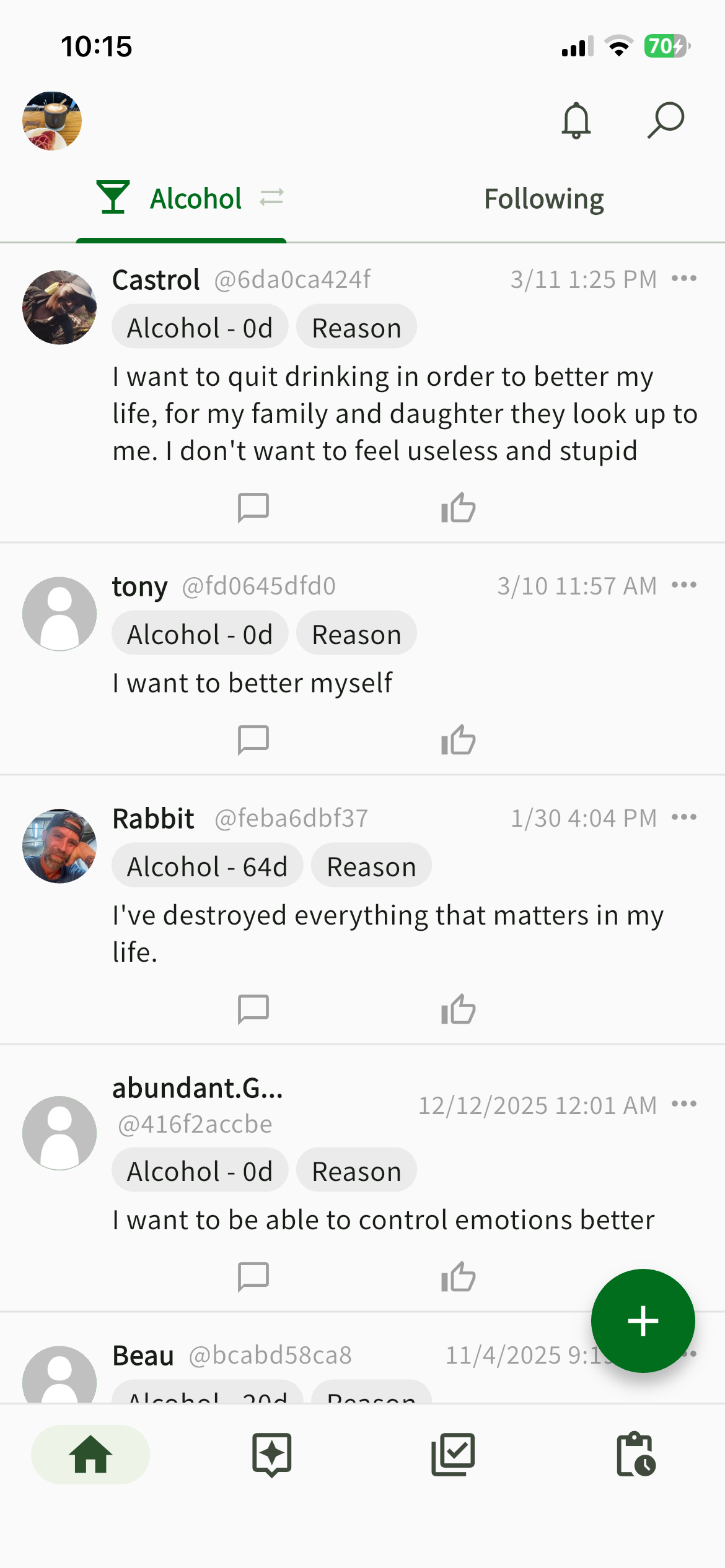

QuitMate
Together, you can quit
Connect anonymously with others who share your struggle. Whether it's alcohol, smoking, gambling, or other habits, you're not alone.