
What If Addiction Isn't the Problem, But a Solution? The Self-Medication Hypothesis Explained

Most people have a go-to routine for a bad day. A glass of wine after a rough meeting. Two hours of mindless phone scrolling. A bowl of ice cream eaten standing up in the kitchen. These little rituals work well enough as pressure valves, letting just enough steam out to get through the evening.
Now imagine the pressure isn’t a bad meeting but years of anxiety, loneliness, or unresolved trauma. The glass of wine becomes a bottle. The scrolling becomes gambling until 3 a.m. The coping mechanism starts causing its own damage, and at that point most people call it “addiction.” But in 1985, psychiatrist Edward Khantzian proposed a different framing. He called it the self-medication hypothesis: addiction, he argued, often functions as a person’s attempt to manage emotional pain that has no other outlet.
Choosing the Right “Medicine” for the Right Pain
Khantzian’s core argument is straightforward. People turn to specific substances or behaviors to ease psychological suffering they can’t handle on their own, whether that’s anxiety, depression, loneliness, or anger.
The interesting part is the specificity. His clinical observations suggested patterns in what people become dependent on. People carrying anxiety tended to gravitate toward sedating substances like alcohol, while those struggling with apathy or depression were drawn to the excitement of gambling or stimulants. Khantzian proposed that people were unconsciously selecting the “medicine” that matched their particular kind of suffering.
Why “Just Quit” Doesn’t Work
If you’ve ever been told “Why don’t you just stop?”, you know how unhelpful that advice is. You may have even blamed yourself, wondering what was wrong with you.
The difficulty of stopping isn’t about weak willpower. Without the addictive behavior, the underlying pain goes unmanaged.
While gambling, a person can temporarily forget anxiety. The loneliness fades. Self-loathing quiets down. Even if the relief is brief, it’s real, and that’s what drives the cycle.
From a neuroscience perspective, addictive behaviors activate the reward system through dopamine, instantly drowning out negative emotions. As covered in more detail in Why People Become Addicted, the brain’s “I want more” circuitry isn’t something you can override with determination alone.
The Roots Run Deep
Beneath addictive behavior, you’ll almost always find something like these: a deep loneliness, a sense of worthlessness, an unsafe home environment, trauma from bullying or abuse, or relentless stress from work or relationships.
Childhood experiences run especially deep. In the ACE (Adverse Childhood Experiences) study published by Felitti and colleagues in 1998, researchers tracked over 17,000 adults and found that people who experienced abuse, neglect, or domestic violence as children had dramatically higher rates of addiction in adulthood. People with an ACE score of 4 or higher were roughly seven times more likely to develop alcohol dependence than those without such experiences.
Facing that kind of pain head-on is frightening and exhausting. That’s exactly why addiction emerges as an escape. For many people, it was the best coping strategy available at the time.
Reframing the Question
The National Institute on Drug Abuse (NIDA) states clearly that addiction is a chronic brain condition, one that causes changes in structure and function. It’s not a matter of weak willpower or a character flaw.
This reframing opens up a more useful question: before “I need to quit,” it helps to ask, “Why did I need this in the first place?” Keeping a journal, or simply taking quiet time to reflect on feelings, can help patterns start to come into focus.
There’s also the isolation factor. When someone is cut off from connection, it’s nearly impossible to find a “safe place” that can replace what addiction provided.
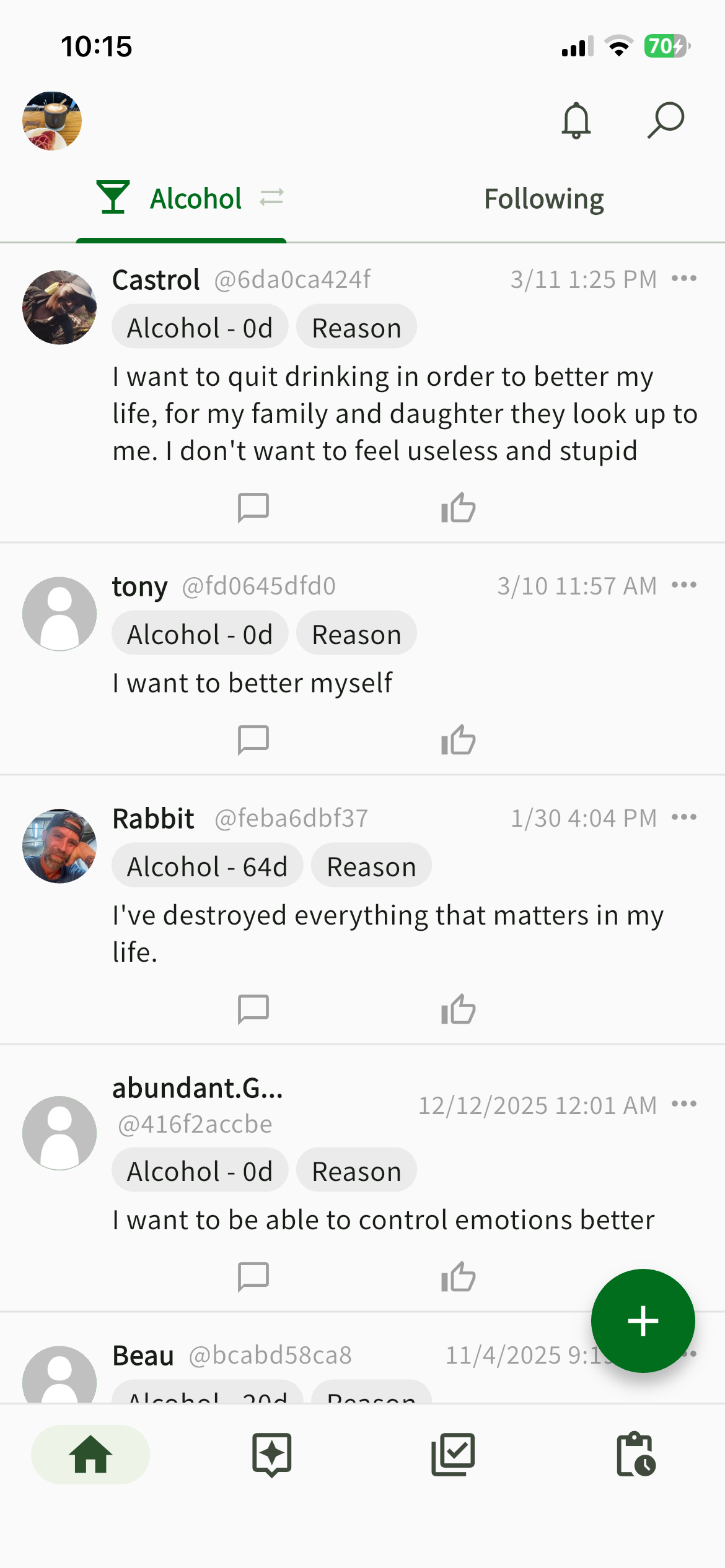
The Rat Park experiment illustrates this well. Rats kept alone in cages turned heavily to drugs, but rats in spacious environments where they could play with others barely touched them. The parallel to human experience is hard to miss: having even one person you feel safe talking to can significantly reduce the pull of “just one more time.” Peer support communities, including online platforms like QuitMate, exist largely because of this principle.
Self-Blame Gets in the Way
As long as someone keeps telling themselves “this is all my fault,” it’s very hard to move forward. Addiction isn’t proof that someone is broken. In many cases, it was a means of survival.
What the self-medication hypothesis tells us is that behind every addictive behavior, there is pain. Recognizing that pain, then finding slightly safer ways to address it, is what recovery actually looks like.
Recovery isn’t linear. There’s no such thing as a perfect path through it. But understanding the “why” behind the behavior is a meaningful place to start.
References
- Khantzian EJ. “The self-medication hypothesis of addictive disorders: Focus on heroin and cocaine dependence.” American Journal of Psychiatry, 142(11), 1259-1264 (1985).
- Khantzian EJ. “The self-medication hypothesis of substance use disorders: A reconsideration and recent applications.” Harvard Review of Psychiatry, 4(5), 231-244 (1997).
- Felitti VJ et al. “Relationship of childhood abuse and household dysfunction to many of the leading causes of death in adults: The Adverse Childhood Experiences (ACE) Study.” American Journal of Preventive Medicine, 14(4), 245-258 (1998).
- Koob GF, Volkow ND. “Neurobiology of addiction: A neurocircuitry analysis.” The Lancet Psychiatry, 3(8), 760-773 (2016).
- NIDA (National Institute on Drug Abuse). “Drugs, Brains, and Behavior: The Science of Addiction.” National Institutes of Health (2020).

QuitMate
Together, you can quit
Connect anonymously with others who share your struggle. Whether it's alcohol, smoking, gambling, or other habits, you're not alone.