
20 Years of Binge-Purge Bulimia, and the Recovery Documented in 266 Posts

Nene left 266 posts on the app.
They’re the record of someone who fought binge-purge bulimia for 20 years, starting in her early teens. In her first two months, she reset 22 times. Her longest streak was 6 days. Then, around January 2025, something suddenly stabilized. She hasn’t relapsed once in 420 days.
This article traces Nene’s 266 posts in chronological order. What happened before and after the turning point? She wrote it down clearly herself.
November 2024: The Day She Joined the App
Nene signed up on November 20, 2024. Her first post read:
I have such wonderful relationships at work, but I’m destroying that trust by calling in sick because of binge-purging. Also, my income is going down starting January, and I never want to go back to working nightlife again.
From day one, she was clear about why she wanted to stop. She didn’t want to lose the trust she’d built at work. She was never going back to nightlife.
That same day, she’d already designed her own recovery program.
- Days with no binge urges: reward myself (cheese, meditation)
- Days with binge urges: try a replacement behavior (take a bath). If it works, reward myself
- Days with binge urges: if I fail, record the time and money spent
The First Two Months
November 25th. Five days without bingeing.
Everyone, listen. Today I came home and went straight to the bath (normally I’d binge immediately), got out and rewarded myself with a drink and some snacks (normally I’d definitely binge), had a reasonable amount, and now I’m getting into bed!!
I got into bed without bingeing. I’m so proud of myself, someone wire me 500 million yen.
The next day, day 6. Reset.
Last night I messed up. Next time I’m aiming for 7 days!
This pattern repeated. Four days, then a relapse. Three days, then a relapse. One day, then a relapse. In December, she was resetting almost every week.
December 13th. Nene temporarily gave up.
I’m giving up until the 18th. When you can drink and you’ve been at the company long enough, you get pulled into entertaining executives… Year-end is full of work dinners that throw off my rhythm. Gaining weight is fine, messing up is fine.
December 25th.
At the end of the day, if binge-purging doesn’t affect my daily life, that’s enough. Compared to last year, I’ve only binged about half as much this year. That’s real progress. I’m learning that you don’t become perfect overnight.
December 26th.
I’ve given up for the rest of the year.
January 9: The Day She Named Her Triggers
After the new year, Nene wrote a particular post.
My triggers are:
- Physical conditions like PMS
- Stress (busy periods)
- Alcohol
- Back-to-back social meals
On the flip side, when I stay home, don’t see anyone, skip the alcohol, and limit social media, things tend to go well.
She clearly identified four triggers for her bingeing. And she’d noticed something: things go better when she doesn’t drink.
But she was still relapsing at this point. January 16th, reset after one day. January 21st, reset after one day again.
January 22: The Last Reset
January 22nd. She relapsed again.
Two days of bingeing in a row. Absolutely the worst.
She posted two more times that same day.
When I’m feeling clear after purging, or when I haven’t been drinking, or when I’m moderately hungry, my mind feels so sharp and good.
If it weren’t for bingeing, my life would be absolutely wonderful.
The next day, January 23rd.
I have a feeling I’ll be able to fall asleep without bingeing tonight!
January 24th.
Eating a normal meal, sleeping soundly, waking up properly in the morning, and showing up to work. It makes me so happy. So why do I still mess up sometimes?
From this point on, she hasn’t relapsed in 420 days.
”I Let Go of the Most Important Thing in My Life”
Eleven days after the turning point, on February 2nd, Nene wrote:
In the process of cutting ties with bingeing, I let go of the most important thing in my life. But I don’t think my life would have changed without doing that. I have no regrets.
What did she let go of? Later posts suggest it was a relationship with her partner. In June, she wrote:
Binge-purging cost me everything. My youth, my education, my career, the person I loved.
I truly loved the person I married, so I convinced myself I had to never be a burden to them.
Making the decision to let go of someone she loved. That was one of the turning points.
Alcohol Was the Binge Trigger
There was another clear change. Nene quit alcohol at the same time as bingeing.
February 11th.
Since I made the rule to absolutely quit alcohol too, to drop my “party drinker” persona and stop drinking even at work dinners, I haven’t binged or purged. There’s no doubt that the psychological effects of alcohol were making my bingeing worse.
She’d identified alcohol as a trigger on January 9th. Putting that insight into action is what coincided with the turning point.
On June 5th, day 134, she went even deeper.
In the end, “wanting to drink” and “wanting to binge” always come as a pair. So I decided to suppress the “wanting to drink” side too, and I’ve been free from both bingeing and alcohol for 134 days.
What Nene Said Actually Worked
February 23rd. One month without bingeing. She summarized what she thought had helped.
The things that probably worked as treatment:
- Taking a casual day off work when things feel too hard
- Not pushing myself (I sold all my designer bags)
- Finding something I genuinely enjoy (studying)
- Mentally writing off every person I can’t stand
- Recording three things I did well and three good things that happened each day (but skipping it when I can’t be bothered)
- Relying on other people as much as possible
- Quitting alcohol at the same time
Then she added:
There were periods when I worked myself to the bone or exercised like crazy, but pushing hard just isn’t for me! I love my bed! And that’s perfectly fine!
”Not Trying Hard” Was the Treatment
Reading Nene’s posts chronologically, one theme rises to the surface: not trying so hard.
February 20th.
I think everyone is probably getting a little better just by living their life as it is, without even noticing. You can get better without watching your weight, without eating three meals a day, without meditating. You can get better without changing anything. And honestly, that feels more realistic.
March 12th, day 49.
I want to understand that you can get better without dramatically changing something inside yourself. You can get better just as you are.
May 12th, day 109.
I used to have a habit of cramming everything in, but I’m starting to believe that going at a relaxed pace won’t make me fall apart. When things work out, they work out whether you’re pushing hard or not. And when they don’t, they just don’t.
May 23rd, day 121. Nene looked back on 20 years of effort.
I tried incredibly hard to recover for 20 years. I used apps that tracked my behavior down to the minute. I once spent an entire month consuming nothing but carrot juice and water. But it was ALL useless! Because the idea that “if I just endure and suppress my urges, I’ll get better” probably just didn’t work for me.
Effort? I don’t really recommend it. Self-blame? Completely pointless. Strengthening your willpower? The people here don’t have weak willpower to begin with.
Day 100, Day 150
May 2nd, day 100. Nene was studying at a food court.
The couple sitting next to me said, “You study so hard. Good things are coming your way.” I almost cried.
It’s been a long road. Twenty years to get here. But right now, I’m the happiest I’ve ever been!
June 21st, day 150. At a hotel breakfast buffet.
An all-you-can-eat buffet. Of course I eat more than usual. But not so much that I can’t skip the purge and just go back to bed for a nap.
It’s not about telling someone “don’t push yourself to the breaking point.” The truth is, only a handful of people can push that hard in the first place. And the ones who do will keep pushing no matter who tries to stop them.
It Wasn’t “Sudden”
When you line up all 266 posts chronologically, the turning point wasn’t sudden at all.
She named her triggers on January 9th. She’d designed her own recovery program back in November. She wrote “you don’t become perfect overnight” in December. All of that happened before the turning point.
Looking at the data alone, it seems like “22 resets, then suddenly 420 days.” But reading the posts, something was steadily building.
March 3rd. Nene wrote:
Having lived with an eating disorder for so many years is something I can’t just ignore. But not being able to tell anyone about it all this time made me feel like I was always lying. I never imagined I’d feel this comforted by knowing someone on the other side of the screen is reading my posts.
Nene wrote that when her parents found out about her bulimia as a student, they hit her. After that, she couldn’t tell anyone. The app’s community was the first place she could speak openly.
Those 266 posts are a record of things she couldn’t tell anyone for 20 years.
Record the Next Day
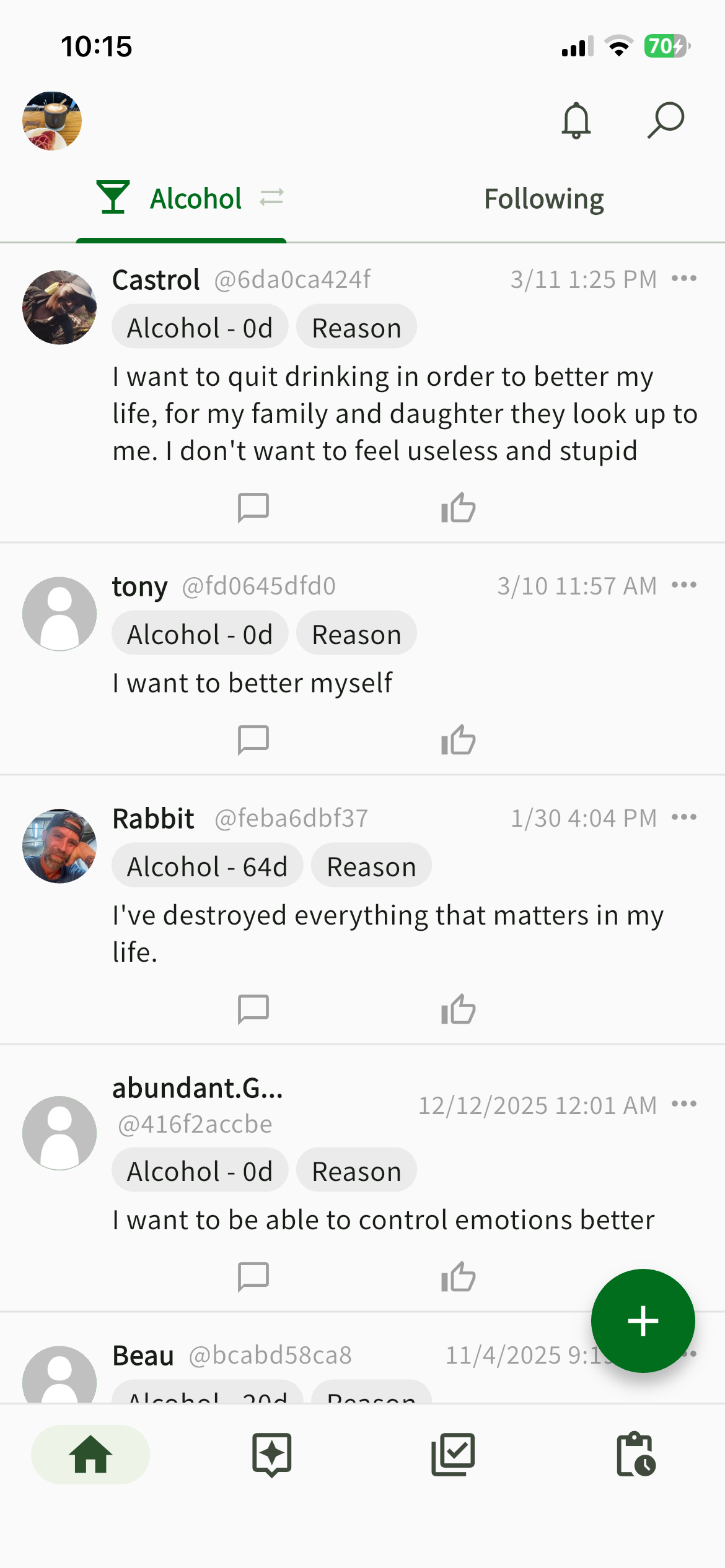
QuitMate has a counter, a community, and a recovery program. When you relapse, you reset to zero and start again from day one. And you can write about what happened that day, knowing someone will read it.
Nene reset to zero 22 times. Every time, she opened the app again and started “day one.” Every time, she wrote a post.
This article is based on user data and community posts from the QuitMate app. Quoted posts have been anonymized, and excerpts have been selected without altering their original meaning. No control group was used, so this does not constitute proof of causation, and self-selection bias is present.

QuitMate
Together, you can quit
Connect anonymously with others who share your struggle. Whether it's alcohol, smoking, gambling, or other habits, you're not alone.